Haav
Highly Amphibious / Autonomous Vehicle
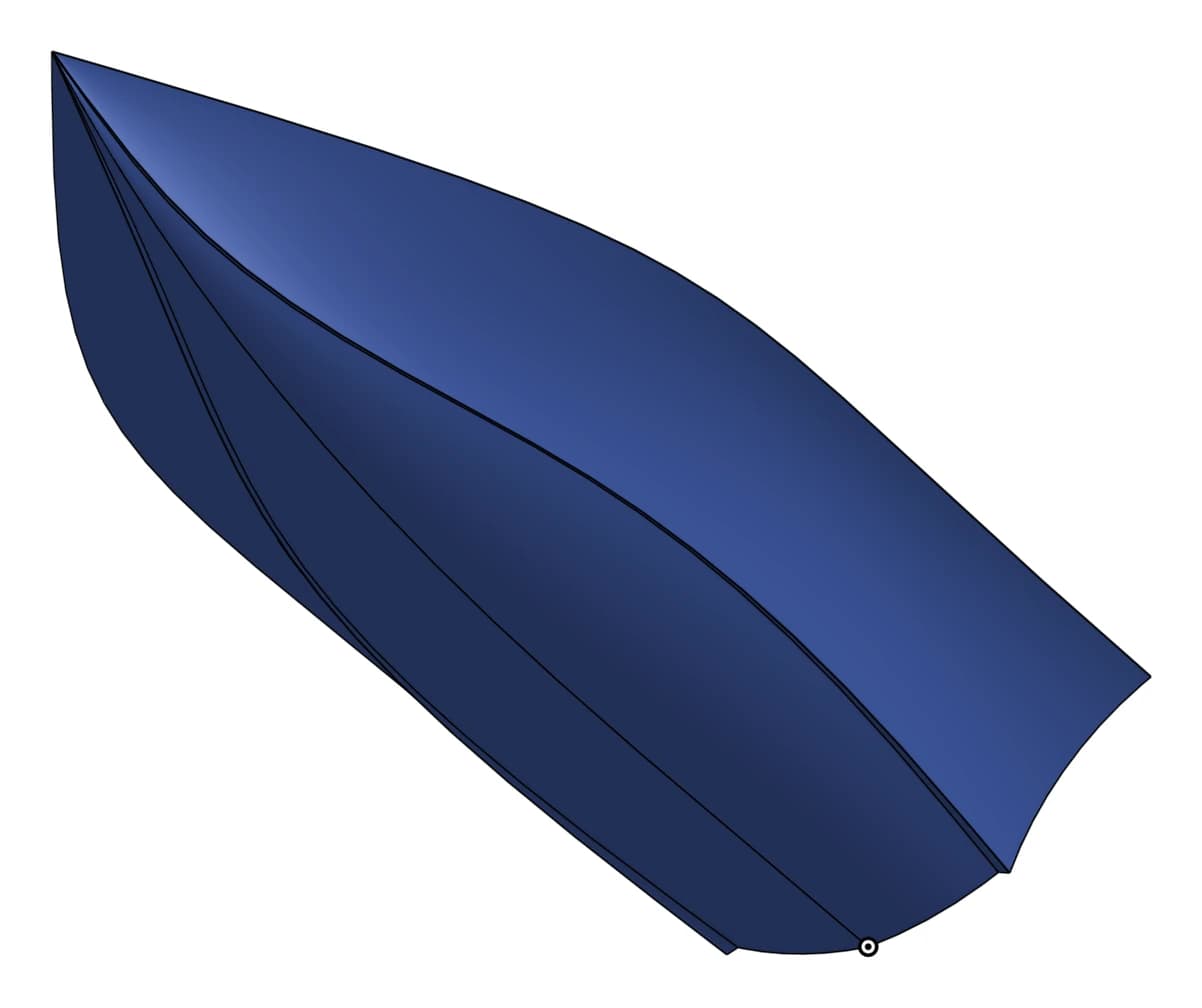
Our current hull design.
We are a student team building an autonomous boat from the ground up at UW-Madison.

The goal is a planing hull with a 30 pound added payload on a 2 mile long course.
Basic Spec
A 4-6 foot composite hull. Autonomy using GPS, IMU and LIDAR.
Primary groups
- 1Hull and optimization
- 2Structural and mechanical
- 3Electrical and power systems
- 4Embedded, firmware and low voltage
- 5Software
Want to work on one of these? Become a member.
Timeline
- Hull design frozen
- Preliminary design review
Full CAD + circuit design and a rough proof of concept (cardboard with boxes for components).
- Critical and long-lead parts are ordered
- Mechanical and electrical design frozen
With the full BOM and the order.
- Build the hull, composite parts and any custom-milled parts
- First float and tow test
With deadweight for the real weight, towed behind a motorized boat.
- Manufacture and assemble everything
With dry fits, electrical assembly out of the boat first, and debugging.
- Build likely spare parts, in parallel
- First nautical mile
It's the first time everything is powered on in the hull, with the first motor and propeller spin in the air and the first propulsion and navigation test commanded by the autonomous pipeline.
- Slow drives on the water
Manual first and then adding autonomy.
- Start increasing speed
- Testing / Tuning
Team
- Marley BarrettProject lead
- A computer engineering major with experience in software and project management. Interned in new product introduction and software engineering at Tesla and in project management at Fincantieri in Trieste, Italy. Has sailed competitively through college and started his own boat detailing business in high school.
- Patrick GrunkleeHull and optimization lead
- An industrial engineering major with experience in optimization, composites and DFM. Was a manufacturing engineer intern at Northrop Grumman, working in solid rocket motor composites manufacturing. Also has supply chain experience at John Deere, working on DFM and cost-optimal material selection for agricultural equipment.
- Will HennenElectrical and power systems lead
- An electrical engineering student who has spent the past two years interning with Xcel Energy, supporting a variety of solar, wind and battery energy storage system projects. Gained hands-on experience with high voltage, data acquisition systems, and the safety procedures and protocols required to work around high-voltage equipment.
- Ryan DrahozalEmbedded and firmware lead
- A computer engineering student with experience in embedded, electrical and electromechanical systems. Built a robotic lifting assistive device for patients with sarcopenia (PCB design, motor drivers, current sensing, safety features). Has also completed two electrical engineering internships at Milwaukee Tool and conducts research at the UW–Madison Simulation-Based Engineering Lab.
- Peyton OlsonStructural and mechanical lead
- A mechanical engineering student and a member of the Baja SAE front suspension team. There, Peyton designed and analyzed the upper and lower control arms in SolidWorks, and machines and welds competition parts (lathe, CNC mill, MIG/TIG).
Advisors
- Vincent RasseAdvisor: controls, battery and powertrain
- Holds an MSc in Mechanical Engineering from ETH Zurich and is a researcher at MIT. A 2025 FSAE world champion, with three years in Formula Student, two of them full time: designed the battery and powertrain, built autonomous stack software, and served as Electrical Safety Officer (certified for high-voltage systems) and Autonomous Systems Responsible. Also a battery design engineer at Tesla, first as an intern and now full time.
- Kevin MacauleyAdvisor: controls, hull and simulation
- A second-year PhD student in Mechanical Engineering at UW–Madison, where he also earned his BS in 2023. Researches swarm robotics in the UW–Madison Marine Robotics Lab, which designs and controls autonomous robots for complex aquatic environments.
Sponsor the build
We are looking for funds, parts and skills. If your company or lab would like to help, or would like to learn more, please fill out the form below!
As a sponsor, you can get your logo on our hull, merch and website, access to our team talent and more soon!